MCS results are in: Four years of improvement in ELA and Math!
There’s progress to celebrate in Modesto City Schools: four consecutive years of improvement in English language arts and math, along with encouraging results in graduation and college and career preparation.
On October 15, the California Department of Education publicly released the 2025-26 state assessments (SBAC, CAST, and ELPAC) and the 2026 California School Dashboard for the first time. These resources give families, educators, and community members an earlier, fuller picture of student learning and school progress.
We took a closer look at the results for Modesto City Schools (MCS). Here are three highlights, school-level bright spots, and ways families can use this information to celebrate and support their students’ learning.
- ELA Results Improved for the Fourth Year in a Row!
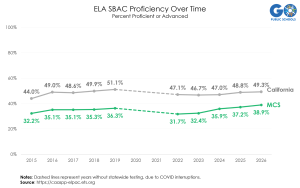
MCS reached its highest ELA proficiency rate since SBAC state testing began in 2015. This year, 38.9% of MCS students scored Proficient or Advanced, an increase of 1.7 percentage points from last year and 7.2 percentage points since 2021–22.
Over that four-year period, MCS’ growth far outpaced the state – another reason to celebrate this sustained progress.
We also saw gains among several student groups, including:
- Black or African American students: +2.7 percentage points
- Latino students: +1.4 percentage points
- English learners: +0.7 percentage points
- Students with disabilities: +1.6 percentage points
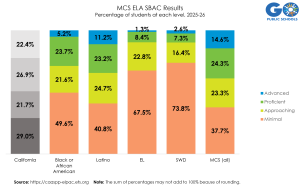
These results show encouraging progress across student groups and reflect the shared work of students, educators, and families.
- Math results are also at their highest level since 2015.
MCS students have made four consecutive years of progress in math, too. This year, 24.3% of MCS students scored Proficient or Advanced in math, an increase of 1 percentage point from last year and 6.8 percentage points since 2021-22.
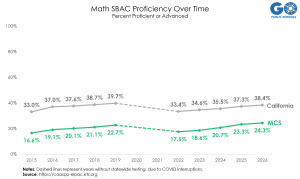
Several student groups also made gains, including:
- Black or African American students: +2.0 percentage points
- Latino students: +0.9 percentage points
- Students with disabilities: +1.3 percentage points
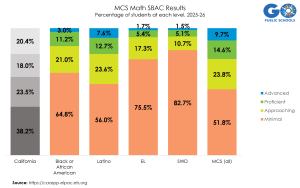
Stronger skills in reading, writing, and math help students succeed across subjects and build a foundation for future college and career opportunities. These sustained gains serve as meaningful progress to build on.
- MCS earned four green ratings on the California School Dashboard
The California School Dashboard brings together information about student learning, school experiences, and preparation for the future, using color-coded ratings across several measures.
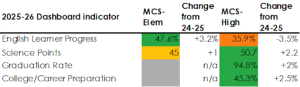
MCS earned four green ratings across its elementary and high school districts:
- Elementary district: English Learner Progress
- High school district: Graduation Rate, College and Career Preparation, and Science
The elementary district made significant gains in English learner progress. The high school district’s graduation rate was particularly strong, exceeding the state average by 6.7 percentage points, while college and career preparation also improved.
Strong graduation outcomes and growing college and career preparation are worth celebrating. Together, they highlight an exciting opportunity to connect students’ learning with their goals for the future, from exploring colleges and earning college credit in high school to navigating applications and financial aid.
More bright spots: Schools making big gains in ELA and math
Districtwide results tell part of the story. Looking at individual schools helps us recognize progress and learn about approaches that can inspire and support continued success across MCS.
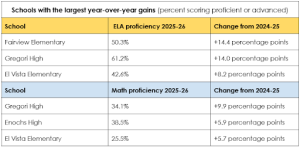
Fairview Elementary recorded the largest ELA improvement for the second consecutive year, with double-digit gains both years. Its proficiency rate reached 50.3%, a 29-percentage-point increase over two years. Gregori High and El Vista Elementary also ranked among the top three schools for improvement in both subjects this year.
These schools offer exciting examples of student progress and an opportunity to celebrate the educators, families, and school communities supporting that success. Learning more about their approaches can help surface ideas to scale and build on this momentum across MCS.
Let’s celebrate the gains and keep building on them together!
What can families do with these results?
These results can help you celebrate your student’s learning, partner with their teachers, and explore opportunities that support their goals.
Start with your student’s results.
If your student took the SBAC assessments in grades 3–8 or 11 last school year, review their score report to see their achievement level in English language arts and math. The results offer a snapshot of their learning at the time of the test. Consider them alongside classwork, grades, and teacher feedback to understand their progress and plan next steps.
- Proficient or Advanced: Your student demonstrated a strong understanding of the skills tested. Ask: “What opportunities can help my student build on these strengths and deepen their learning?”
- Developing or Minimal: Your student is still building the skills measured by the assessment. Ask: “Which skills is my student developing, and what instruction and support will help them take the next step?”
Make a plan together at your next parent-teacher conference.
Bring the score report and ask your student’s teacher:
- What strengths and progress can we celebrate, including growth since the assessment?
- What is one learning goal we can work toward together?
- What will my student practice at school, and what can we try at home?
- When can we check in to discuss progress and next steps?
Together, you can leave the conversation with a shared goal, specific actions, and a plan to stay connected. GO’s family-led conference tools can help you prepare for these conversations, including resources focused on literacy, English learner reclassification, and your student’s overall learning.
Connect today’s learning to future opportunities.
For families with middle or high school students, conversations about learning are also a chance to explore college and career goals. Your student’s interests, strengths, and aspirations can help guide the discussion. Ask their counselor:
- What courses and experiences can help my student explore their interests and future goals?
- Which courses will help my student prepare to apply to California’s public universities, and how can we plan for them?
- What opportunities are available to earn college credit while still in high school?
- Where can our family get help exploring colleges, completing applications, and applying for financial aid?
GO’s A Parent’s Guide to College Conversations and A Parent’s Guide to Financial Aid can help your family explore these next steps. If you need help getting started, watch our financial aid walkthrough.
Explore the bigger picture: patterns, progress, and opportunities to build on success
Take a look at your school’s results at the California Test Results website and the California School Dashboard. GO’s How to Access Assessment Data and How to Access Dashboard Data guides offer step-by-step instructions for navigating these sites.
As you explore the data, consider these questions:
- Progress: How have results changed over time?
- Comparison: How do the results compare with state averages and those of other schools?
- Equity: Which student groups are making progress? Where do differences in outcomes remain?
- Bright Spots: What can we learn from schools making strong gains, and how can effective practices be shared more widely?
Notes: Districtwide ELA and math figures combine results from Modesto City Elementary District and Modesto City High School District. “Proficiency” refers to students scoring Proficient or Advanced. Beginning with 2025–26 results, the achievement-level labels for these assessments are Advanced, Proficient, Developing, and Minimal. The criteria and score thresholds for these levels have not changed. Learn more in the California assessment reporting resources.


